Who is on the ice?
Most shifts have five skaters and one goalie. The skaters are three forwards and two defensemen. Players move all over the ice; these names describe their roles.
ForwardsLW · C · RW
DefenseLD · RD
GoalieG
 RESTON RAIDERS10U White Quick Rules
Search calls, clock rules, gear, or off-ice questions.
Reston Raiders 10U White · 2026–27
A rink-side guide for Reston Raiders 10W families in CBHL’s (05) 10U Wales Blue division — Tier II youth hockey, B level.
THE FIRST QUESTION
00 / HOCKEY BASICS
Before offside and icing, know who is on the ice and what the lines are telling you.
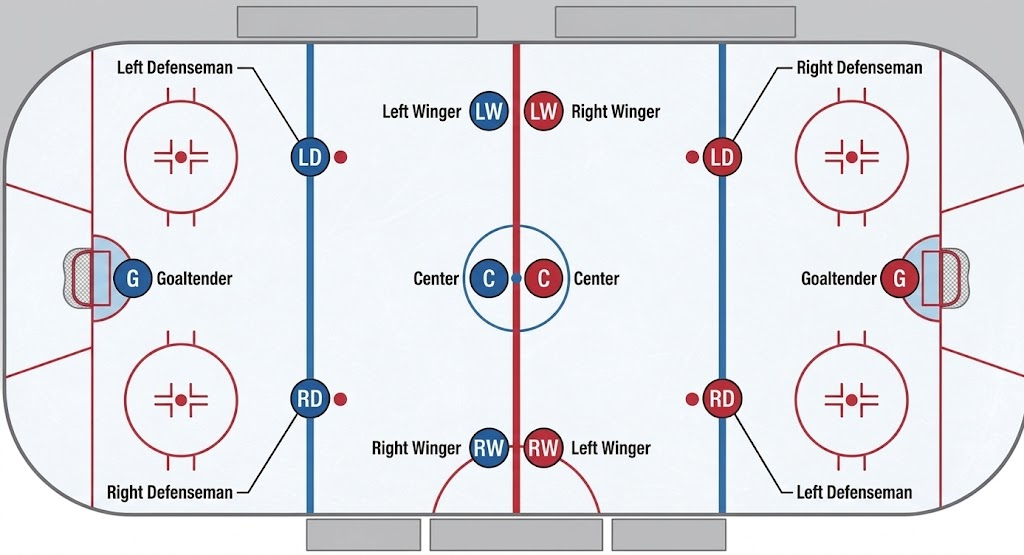
Most shifts have five skaters and one goalie. The skaters are three forwards and two defensemen. Players move all over the ice; these names describe their roles.
Your team attacks one end and defends the other. The neutral zone sits between the blue lines.
This guide is for Reston Raiders 10U White (RESTON RAIDERS 10W), CBHL 2026–27, (05) 10U Wales Blue. CBHL registers these teams as Tier II; Wales is its B level. The USA Hockey youth rules apply, together with PVAHA requirements and CBHL’s published local rules.
01 / BEFORE THE PUCK DROPS
Most game-day surprises are preventable. Use this checklist before leaving the house and again when you arrive.
A player must be registered for the season and properly rostered on the team. PVAHA’s certified 1-T roster should be available at games; players who are not properly rostered are ineligible.
Roster & registrationYouth rules require a HECC-certified helmet and full facemask, fastened chin strap, and a certified neck laceration protector. BNQ-certified neck protection is accepted through 2026–27. A mouthguard is recommended at 10U; USA Hockey’s mandate starts at 12U. Wear all other required protective equipment. (Rule 304.)
Equipment remindersCBHL provides a three-minute warm-up. Stay on your team’s half. Do not cross center ice or shoot toward the opponent. Leave the ice promptly when warm-up or a period ends.
Game flow basicsConfirm the exact game time, roster status, uniform color, and tournament or league add-ons with the team manager. The rulebook is the baseline; the game sheet can be more specific.
02 / IN THE GAME
Watch the blue line and the red line. Once those two ideas click, a lot of hockey starts to make sense.
An attacking player cannot enter the attacking zone before the puck.
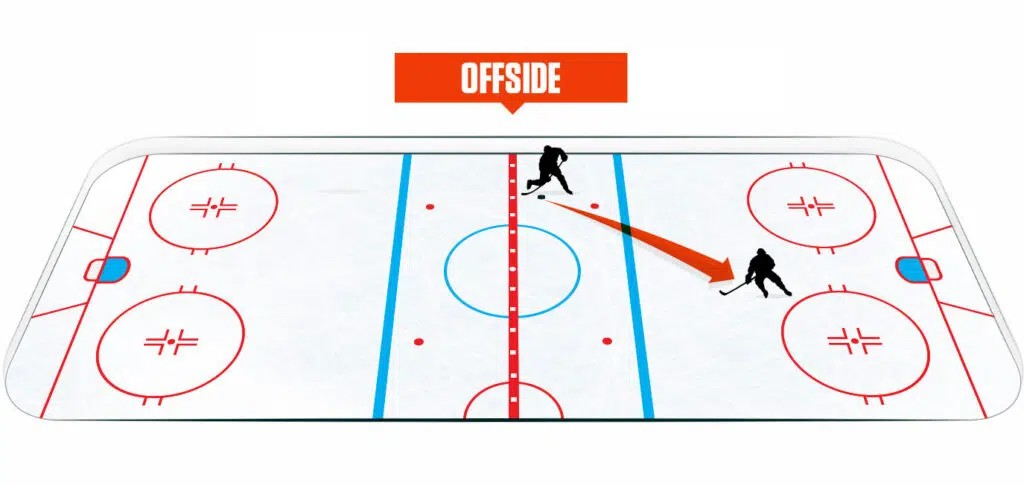
When the puck completely crosses the blue line, at least one attacking skate must still be on the line or on the neutral-zone side. The stick does not decide offside.
A team shoots, bats, or deflects the puck from its own half past the opponent’s goal line.
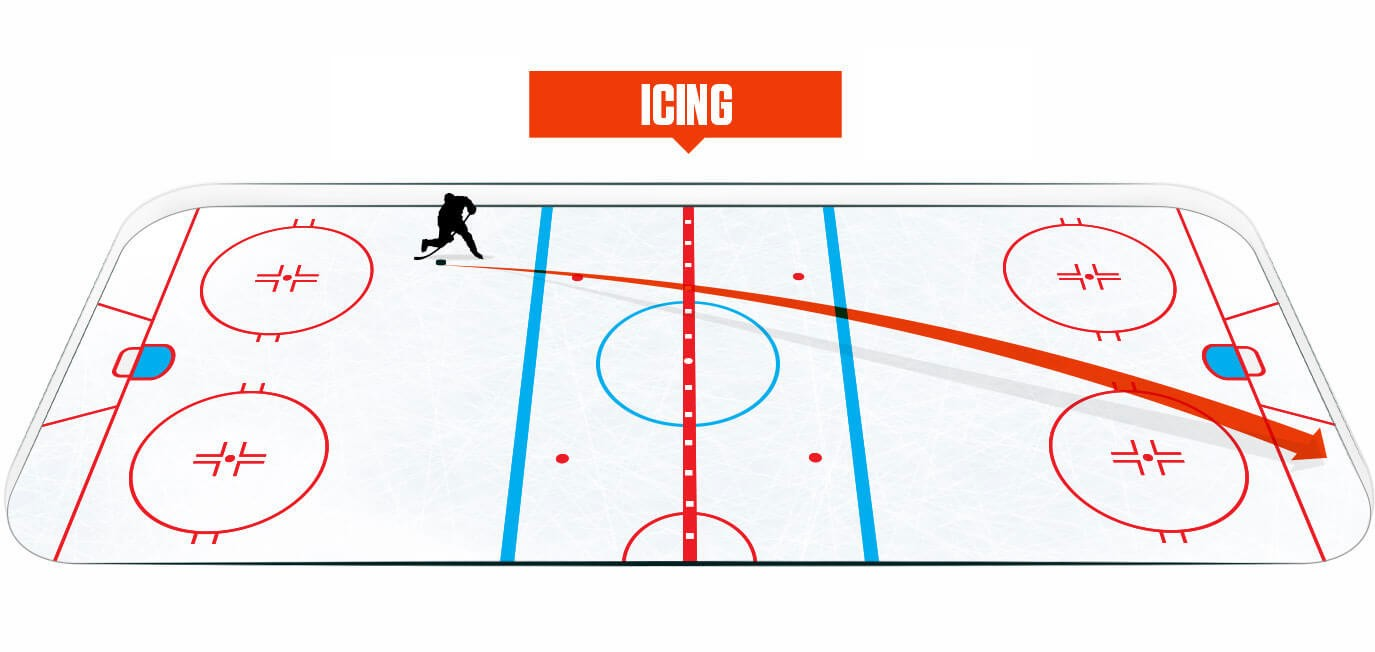
Play stops and the face-off goes to the offending team’s end zone. At 10U, icing still applies when your team is shorthanded. Teams may change players after icing; the NHL’s no-change restriction does not apply here. (Rules 624 and 204.)
WATCH IT IN MOTION
A visual refresher for the blue line, red line, and goal line.
WHISTLE DECODER
CBHL Rule 8.2 sets these times for our division’s 15-minute periods. USA Hockey Rules 402–405 explain the penalty types.
CBHL 2026–27 Rules 8.1 and 8.6 · 10U Wales Blue
CBHL’s published standard for this division is three 15-minute periods. The clock normally stops at whistles. Warm-up is three minutes, with one-minute breaks between periods.
Rule 8.6 calls for two full periods, then a third period set to half the remaining ice-slot time, capped at the normal period length. The scorekeeper must document why a game was shortened.
The rink’s scheduled end time is separate from the game clock; there is no universal 10:00 cutoff.
These are CBHL local game-management rules for games between CBHL teams. They sit alongside USA Hockey and PVAHA rules.
If one team reaches a 10-goal lead at any point, the game terminates immediately. The score and statistics are final, even if the scoreboard still shows time such as 2:34.
In the third period, a five-goal lead starts a continuously running clock. Penalties also run on running time. Stop-time resumes when the goal difference falls to four or less.
Any period → game ends
Third period → running clock
Second period → stop time
Regular-season CBHL games are scheduled with no overtime or shootout, so a tie can stand. That is not an exhibition-only rule. The running-clock and ten-goal rules also explicitly apply to exhibition games. For an exhibition, confirm tie handling on the game sheet; playoffs can require overtime and a shootout to determine a winner.
VII / OFFICIALS’ SIGNALS
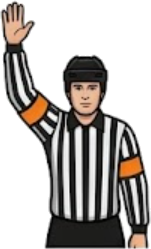
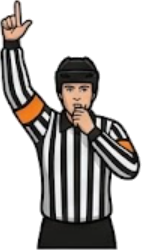
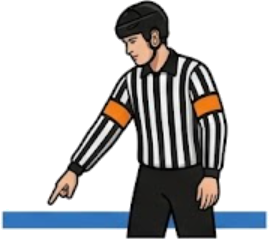
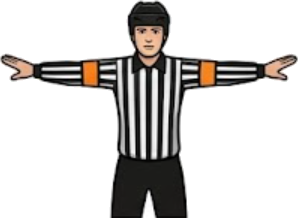
A signal is the official’s quick visual message. The whistle tells you when play has actually stopped.
One arm held straight up means a penalty is coming, but play has not stopped yet.
The linesperson signals that the puck traveled too far from behind the center red line.
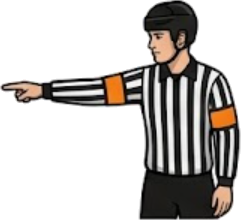
The linesperson is pointing out an offside play or indicating which way the zone call goes.
Both arms swept sideways means no icing, no offside, or no goal on that play.
The official points toward the net to confirm that the goal counts.
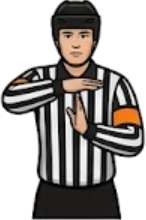
Hands making a “T” means a time-out has been requested or granted.
WHILE PLAY IS MOVING
Let the officials place the next face-off; don’t restart the play yourself.
Slashing, hooking, and cross-checking can turn a normal battle into a penalty.
Body checking is prohibited at 10U. Legal competitive contact while playing the puck is allowed; deliberate body checks are penalized. (Rule 604.)
Ask a coach for a calm explanation later; never argue or retaliate on the ice.
03 / OFF THE ICE
PVAHA’s local rules are as much about eligibility, safety, and respect as they are about the game itself.
SAFE & RESPECTFUL
PVAHA adopts USA Hockey and U.S. Center for SafeSport policies covering sexual, physical, and emotional misconduct; bullying, threats, harassment, and hazing. Adults with regular access to youth must meet training and screening requirements.
If something feels wrong, tell a trusted adult or team leader.DISCIPLINE
A suspended player, coach, or team official cannot participate in any part of the next scheduled game—including before, during, or after the game, and the locker room—until the suspension is completely served.
A forfeited game does not satisfy a game suspension.TEAM BUSINESS
PVAHA controls when certain teams may hold tryouts, recruit, or offer next-season agreements. Rules differ by tier and age, so ask your association before committing or changing teams.
A parent signature does not override an Affiliate restriction.PARENT / PLAYER CHECK
Player safety, fair play, and respect are not optional extras. They are the point of the program.
PVAHA policy themes, simplified04 / NHL ≠ 10U
NHL clips can teach the idea of a play, but they are not the authority for a PVAHA game.
| Topic | PVAHA + USA HOCKEY10U White game | NHLPro game |
|---|---|---|
| Offside | Immediate offside. No delayed/tag-up offside at 10U. | Delayed offside allows attackers to clear the zone and tag up. |
| Icing | Icing applies even when shorthanded. Player changes are allowed. | Shorthanded teams may ice the puck. The team called for icing generally cannot change players. |
| Game clock | Three 15-minute stop-time periods under CBHL Rule 8.1; Rule 8.6 addresses a shortened third period. | Three 20-minute regulation periods. |
| Body checking | Not allowed at 10U. Legal competitive contact is allowed. | Body checking is permitted within the NHL’s checking rules. |
| Safety gear | Youth helmet, full facemask, and certified neck protection required. Mouthguard recommended at 10U. | NHL helmet and visor rules differ from youth full-face protection requirements. |
KEEP THESE LINKS
Use the official sources below for an edge case, a roster question, or a league-specific decision.